Ashland's Comprehensive Plan - Transportation Element (extract):

"Ashland has a vision - to retain our small-town character even while we grow. To achieve this vision, we must proactively plan for a transportation system that is integrated into the community and enhances Ashland's livability, character and natural environment...The focus must be on people being able to move easily through the city in all modes of travel, Modal equity...ensures that we will have the opportunity to conveniently and safely use the transportation mode of our choice, and allow us to move toward a less auto-dependent community."
Showing posts with label USA. Show all posts

Saturday, April 25, 2020

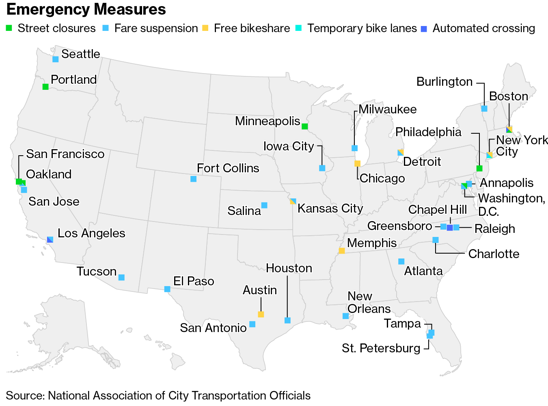
Mapping How Cities Are Reclaiming Street Space

To help get essential workers around, cities are revising traffic patterns, suspending public transit fares, and making more room for bikes and pedestrians.

"The fight against coronavirus has brought cities to a standstill. With roughly one third of the global population under lockdown, vehicle traffic has all but vanished on the world’s busiest roads and highways. Public transit ridership in global metros has dropped by more than 80% since early January. For residents in one U.S. city, Seattle, the average daily travel distance has gone from the length of the Las Vegas Strip to that of a bowling alley..."


Thursday, March 19, 2009

Where the sidewalk ends

extract courtesy seedmagazine.com

At an intersection in Portland’s Chinatown, the asphalt street suddenly gives way to an urban oasis. A pair of massive, granite planters with palm trees flank the entrance to the street, which opens onto a one-block space paved with concrete squares. There are no white lane dividers or sidewalks. Instead, rough-hewn granite columns distinguish places for pedestrians and places for cars.
“The idea of this street is that it’s designed like a public square but it’s open to traffic,” said Ellen Vanderslice, a project manager for the Portland Department of Transportation. “We were very consciously trying to create a body language of the street that tells people something different is going on here.”

...The approach appears to be working, she said. “Pedestrians tend to just mosey across the street every which way,” Vanderslice said. “And drivers slow down and pay attention.”
Portland’s so-called “festival street,” which opened two months ago, is one of a small but growing number of projects in the United States that seek to reclaim streets used by cars as public places for people, too. The strategy is to blur the boundary between pedestrians and automobiles by removing sidewalks and traffic devices, and to create a seamless multi-purpose urban space...
[ lots more ]

Tuesday, March 17, 2009

Main Street Dims Its Lights

Ashland's award-winning investigative reporter Bob Plain who for many years sleuthed for the Daily Tidings "City Beat" has returned to his hometown of East Greenwich, RI and is now Managing Editor of a newly-launched online local newspaper My02818.com .

A recent article shows that East Geenwich is, like Ashland, having ideas about street lighting, sustainability and safety issues.
Main Street Dims Its Lights
"...“We wanted to see if the cobra lights are really needed,” he said. “If people decide it’s not working, we’ll change it back.”The idea percolated out of the Downtown Planning Initiative, a subcommittee of the East Greenwich Planning Board. The town council approved the idea in December and National Grid turned off the cobra lights last week.He said the change will also save the town money on its electric bill and said the reduced light will have a “natural traffic calming effect” on Main Street. “Traffic will definitely slow down”... [more]

Another article in the newspaper shows that they too are also looking at light rail options for their community.
article: An East Greenwich Train Station

"...East Greenwich and the state have expressed interest in locating a rail station in East Greenwich since 2004, and some conceptual groundwork for transit-oriented development zones in town has already been completed..."
[more]

Tuesday, March 10, 2009

In Ashland, Cars Rule - OK?

A local resident recently wrote to the Editor of Ashland's Daily Tidings newspaper:

Pedestrians, save gas by not making traffic stop for you
Pedestrians! Don't make autos stop for you at crosswalks! Although autos are required by law to stop for pedestrians, we'd use less gasoline and create less pollution if pedestrians waited for traffic to clear before crossing, or walked half a block to the closest stoplight...So all you oh-so-green Ashlanders, do your bit to reduce our dependence on foreign oil and lessen the risk of global warming — don't make vehicles stop for you at crosswalks!

read entire letter at [link]

Perhaps a better solution might be to eliminate all the traffic signals and reduce the speed of vehicles such that pedestrians could safely cross anywhere between the slow-moving traffic. Drivers would be watching the pedestrians rather than the green-for-GO signal above them.
Sounds like - Shared space ! see video - Introduction to Shared Space

Thursday, March 05, 2009

Impromptu Shared Space Calms Soho Intersection

by Ben Fried on March 5, 2009 courtesy of StreetsBlog.org

...Reader Tim Koelle sends this report of a busted traffic signal gone terribly right at the intersection of West Broadway and Grand yesterday morning:
I watched for an hour while cars, trucks and pedestrians shared this space quietly... with civility! Little honking, no aggressive driving, no traffic cop. Why? Because the light was out.
No one had to speed up and honk to make the green light on time; no one honked or changed lanes to take advantage of the narrow window of time the light granted them. Everyone came to a stop, looked around (wondering why the light was dead, and what they should do), and proceeded slowly thru.
Instead of a line of cars waiting for the light to change, alternate sides vying with each other for the few precious moments allowing them the right to pass thru... no one had to wait very long. And in fact the alternate sides traded back and forth, almost at a one-to-one ratio. No one had to wait, so no one got stuck in a line, so no one sped up, so no one honked, so there was no need for aggressive driving! Even pedestrians got their due...
[more, with comments]

It reminds me of when a power cut in Downtown Ashland happened just at evening rush hour, shutting down all the traffic signals.
Everybody just quietly took their turn - bikes, pedestrians and cars all watching each other, rather than waiting for the eye-in-the-sky to tell them to GO !
I have also heard reports of early morning commuters stopped and waiting at red lights on Lithia Way - for the non-existing cross traffic. Do we actually need traffic signals in Ashland?
Comments welcome.

Sunday, March 01, 2009

America before streets were civilised

Some Reflections from 2017
by Ben Hamilton-Baillie Hamilton-Baillie Associates Limited, Bristol, United Kingdom

Contribution by the author to the world wide collaborative project “Messages for America: World-wide experience, ideas, counsel, proposals and good wishes for the incoming Obama transportation team”. See www.messages.newmobility.org for latest version of this report of the New Mobility Agenda

Looking back at 2009 from the closing days of Barrack Obama’s presidency, it is sometimes surprising to appreciate how much has changed in the relationship between people, places and traffic, and to grasp the effect of the dramatic policy change that took hold back then. Aware that successful cities are judged on the quality of their public realm, policy makers began to transform city streets from soulless arteries for vehicles into spaces shared equally by pedestrians, cars, taxis, buses, bicycles and every kind of social activity. Given the huge benefits that sprang from the multiple use of public urban space for safety, movement, accessibility, and economic vitality, it is now hard to recall how different typical streets once looked.Until 2009, they looked like everywhere else. In those days. the roadways providing running space for vehicles were carefully separated from pedestrian spaces. Kerbs, steel barriers, bollards and paint markings reinforced this separation. Different organisations looked after the two worlds that this segregation created, one managed by “traffic engineers”, the other by “urban designers”. Traversing this divide required specific crossings controlled by traffic lights, buttons and beeping signals. Standardised signs, traffic islands, poles, control boxes and illuminated bollards littered the spaces between buildings. Behaviour in the roadway was controlled by the state via cameras, and normal social courtesies were discouraged.Inspired by pioneering examples from Europe, and particularly by the work of Hans Monderman from The Netherlands, people suddenly realised that all this highway clutter was no longer needed. Without traffic signals, signs and markings, traffic flowed slowly and more smoothly. Congestion diminished. Casualty rates, particularly for children and vulnerable pedestrians, declined sharply. Shops flourished as pedestrian footfall increased, with people negotiating their way through slowly moving traffic using informal communication and courtesy. Bus companies reported more reliable running times. Every street in America began to reflect its history, context and purpose, reflecting the richness and diversity of the country’s huge geography and infinite variety.Only the most busy traffic arteries remained segregated, such as the freeways and major arterial highways. All the remaining city streets became “shared space”. Back in 2009, most found the change surprising and a little daunting. It seemed almost perverse and counter-intuitive to take away rules and regulations, signs and signals, and to rely on people’s commonsense and adaptive skills. And yet, just as crowds seem to develop an intuitive choreography in busy complex spaces such as railway station forecourts and departure lounges, so drivers and pedestrians engaged in a new respectful relationship at busy intersections. Speeds remained below 20 mph. Delaying a bus or lorry became a serious social gaffe. Eye contact and hand signals became more sophisticated. Driving behaviour adapted to the times of day and rhythms of the city, with quite different styles when schools were coming out, when the bars were closing, or when streets were empty before dawn. Pedestrians walked where they wished to walk. Bicycling became the norm in the low speed, smooth flowing streets. Taxi drivers still grumbled. Traffic signal engineers were retrained as park keepers and window cleaners. Civility flourished.So many changes in the past eight years, but none more significant for the quality of everyday life in America as the moment when engineering merged with creativity and commonsense.
Sunday, February 22, 2009

Cities try to improve crosswalk safety

By Larry Copeland, USA TODAY
Cities alarmed by deaths and injuries of pedestrians are ramping up efforts to make crosswalks safer for people on foot, especially seniors and children who need more time to cross streets.
A pedestrian is killed in a traffic crash in the USA every 110 minutes; one is injured every nine minutes, according to federal data. Crosswalks can be especially perilous for the elderly. ..

In 2006, 471 pedestrians nationwide were killed in crosswalks, down slightly from 488 10 years earlier, according to the NHTSA. Several factors contribute to danger at crosswalks:
•Highways are designed and built primarily to accommodate vehicles, not pedestrians.
•Most pedestrian accidents at intersections involve turning vehicles. Drivers who routinely fail to yield to pedestrians in crosswalks run little risk of being cited unless they actually strike a pedestrian.
•About one-third of pedestrian deaths result from their disobeying traffic signals or using poor judgment, according to federal data.

see story of yet another crosswalk accident in Ashland on Feb. 18. 2009 :
Car Hits Woman Crossing

Saturday, February 21, 2009

Bike vs. Car vs. Transit

by Elizabeth Press on May 30, 2008

see who wins the NYC commute at StreetFilms

Thursday, February 19, 2009

Shared-Use Streets

An Application of “Shared Space” to an American Small Town
by Celeste Gilman and Robert Gilman

[excerpted from a paper presented to 3rd Urban Street Symposium,June 24-27, 2007 Seattle, Washington]

Langley, Washington, a semi-rural town of 1,050 people, is expected to grow by 40 to 100 percent over the next 20 years. One of the town’s biggest assets is its pedestrian friendly character, which is currently supported by low traffic volumes.
Anticipating this growth, the City is developing new street design standards to support all users and modes. One of the new street types is “shared-use,” which mixes pedestrians, bicyclists, and drivers in a low-speed environment that emphasizes the community function of the street... [more]

Monday, February 16, 2009

Streetless in Seattle
An innovative shared-space design is taking shape in the city’s developing South Lake Union neighborhood.

...The Terry Avenue North street-design guidelines, which cover a six-block stretch linking downtown to Lake Union, radically depart from the standard American approach to traffic design. Instead of segregating vehicles and pedestrians, the project aims to encourage people to share a single travel lane with slow-moving cars. “We’re breaking some conventions here,” says Lyle Bicknell, the city’s urban-design project manager for Terry Avenue North.
Bankrolled by Microsoft cofounder Paul Allen and his company, Vulcan, the once languishing industrial district is evolving into a world-class mixed-use biotechnology hub...[more]