Ashland's Comprehensive Plan - Transportation Element (extract):

"Ashland has a vision - to retain our small-town character even while we grow. To achieve this vision, we must proactively plan for a transportation system that is integrated into the community and enhances Ashland's livability, character and natural environment...The focus must be on people being able to move easily through the city in all modes of travel, Modal equity...ensures that we will have the opportunity to conveniently and safely use the transportation mode of our choice, and allow us to move toward a less auto-dependent community."

Thursday, July 28, 2022

Hans Monderman: Rethinking the design of streets and public space.

 Video: https://youtu.be/bjBGokenEhQ

An Urban Design London and Urban Design Group Lecture

Hans Monderman has been one of the most significant influences on the current debate about the design of streets and spaces in the UK. A traffic engineer and road safety specialist from Northern Holland, he is celebrated as the pioneer of shared space as a means to influence speed and driver behaviour. Monderman has been the inspiration behind scores of towns and villages which work without road markings, traffic signs, signals, kerbs, barriers and bollards. ‘Most engineers, when faced with a problem, try to add something,’ he says. ‘My instinct has always been to take something away.’ Following a short introduction by Rob Cowan, Hans explains his approach, work and experiences. Copyright: Esther Kurland. Director. Urban Design London

Shared Space: Dutch Woonerfs and Shopping Streets Explained


Video: https://www.youtube.com/watch?v=ZxFu6rUH9cY


Also:
Resources relating to shared space: Review of Hamilton-Baillie's 2003 paper "Urban design: Why don’t we do it in the road? Modifying traffic behavior through legible urban design" https://cyclingresearchreview.com/201...


Interview with Dick van Veen about "Mode-oriented Street Design": https://www.linkedin.com/pulse/mode-o...


Bicycle Dutch blogs "Crowded cycleways lead to new urban design approach" https://bicycledutch.wordpress.com/20...


Friday, May 22, 2020

Bristol reveals plans to pedestrianise historic centre in Covid-19 revamp

Mayor sees pandemic as chance to change travel habits and revitalise city
May 21 2020
A scheme to turn part of Bristol’s historic centre into a pedestrian-only zone within months has been set out as part of plans to change how people get around the city during and after the Covid-19 crisis.
The city council hopes that by the end of the summer a tranche of the Old City area – which includes restaurants, cafes, independent shops and Bristol crown court – will be free of traffic...

Saturday, May 09, 2020

The UK government is urging the public to walk and cycle to work instead of using public transport or driving.

How we will travel while maintaining social distancing is one of the biggest challenges the government faces as it seeks to start to lift the lockdown.
It has led communities, UK transport groups and public health experts to call for radical changes - some already happening globally - such as wider pavements, traffic restrictions and cycle networks.
Such changes would prevent further waves of infections, improve air quality and public health, and help countries achieve their climate goals, they say.
The decline in road use during the lockdown has seen dramatic falls in air pollution - an unforeseen benefit of the pandemic - as well as quieter roads for cycling.

BBC News 5/9/20   https://www.bbc.com/news/uk-52524807

Council approves Healthy Streets program to ease crowding on sidewalks, trails

“In neighborhoods that are lucky enough to have sidewalks, people are crowding onto 5-foot pathways next to 40-foot roads,” said Council Member Natasha Harper-Madison. “This effort isn’t just about the benefit of joggers and cyclists – it’s about people in wheelchairs who need to safely get to the pharmacy; it’s about grocery store clerks and health workers who need to get to their bus stops.”

Friday, May 8, 2020 by Ryan Thornton
https://www.austinmonitor.com/stories/2020/05/council-approves-healthy-streets-program-to-ease-crowding-on-sidewalks-trails/

Friday, May 08, 2020

Seattle will permanently close 20 miles of residential streets to most vehicle traffic


May 7, 2020

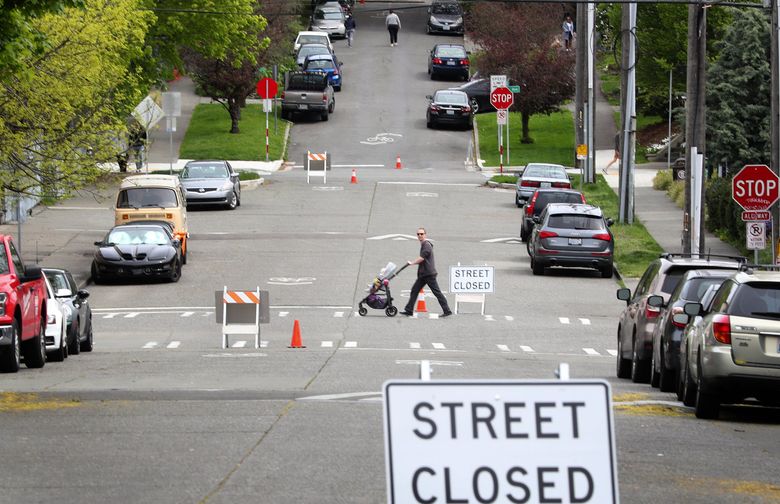
Nearly 20 miles of Seattle streets will permanently close to most vehicle traffic by the end of May, Mayor Jenny Durkan announced Thursday.

The streets had been closed temporarily to through traffic to provide more space for people to walk and bike at a safe distance apart during the coronavirus pandemic.

Now the closures will continue even after Gov. Jay Inslee’s stay-at-home order is lifted.


A pedestrian crosses East Columbia Street in the Central District, which is closed to through traffic to give people space to walk and bike.  (Ken Lambert / The Seattle Times)

Sunday, May 03, 2020

City leaders aim to shape green recovery from coronavirus crisis

Mayors coordinating efforts to support a low-carbon, sustainable path out of lockdowns
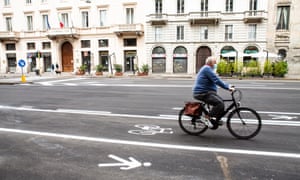
A cyclist in a new bike lane in Milan
A cyclist in a new bike lane in Milan. 
The city has introduced one of Europe’s most ambitious cycling and walking schemes. 
Photograph: Roberto Finizio/Getty Images
...Many cities have already announced measures, from hundreds of miles of new bike lanes in Milan and Mexico City to widening pavements and pedestrianising neighbourhoods in New York and Seattle.
The initiatives are designed to allow people to move around urban spaces safely in a world where physical distancing will be the norm for the foreseeable future – and do so without sparking a drastic increase in air pollution...

Saturday, April 25, 2020

Streetscape patios for Ashland ?

One opportunity to enhance Ashland’s streetscape is in the downtown core with temporary and/or permanent streetscape patios.    
The downtown core already has a strong existing base of restaurants, businesses, and greenspace.   Adding to it will help continue economic prosperity for downtown businesses while maintaining the small town charm and character that helps attracts visitors to Ashland.  Streetscape patios are patios that extend the width of sidewalk to provide space for restaurants to provide outdoor seating and boutiques or other businesses to set‐up small displays similar to what might be seen at an open air marketplace...

See White Paper prepared for Ashland Trandpotation System Plan  [2011]


L.A. needs more street space for walking

By THE TIMES EDITORIAL BOARD   APRIL 18, 2020

...Angelenos shouldn’t have to navigate this social distancing obstacle course. There’s plenty of lightly used space available at this very moment that could be dedicated to exercise and the pursuit of fresh air. It’s right there, in the middle of the street...
...COVID-19 creates an unprecedented opportunity to experiment. Before, ambitious projects to slow speeding cars and make streets safer for pedestrians and bicyclists were dropped after commuters complained. Now? It’s quite possible that walkers and bikers outnumber drivers at the moment. There’s a constituency of homebound people desperately craving outdoor space...

see article: L.A. needs more street space for walking


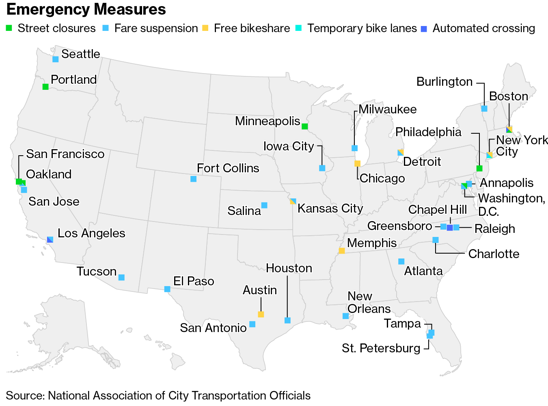
Mapping How Cities Are Reclaiming Street Space

To help get essential workers around, cities are revising traffic patterns, suspending public transit fares, and making more room for bikes and pedestrians.

"The fight against coronavirus has brought cities to a standstill. With roughly one third of the global population under lockdown, vehicle traffic has all but vanished on the world’s busiest roads and highways. Public transit ridership in global metros has dropped by more than 80% since early January. For residents in one U.S. city, Seattle, the average daily travel distance has gone from the length of the Las Vegas Strip to that of a bowling alley..."


Wednesday, December 26, 2018

Oslo's car ban sounded simple enough. Then the backlash began...

https://www.theguardian.com/cities/2017/jun/13/oslo-ban-cars-backlash-parking

When Oslo decided to be the first European city to ban cars from its centre, businesses protested. So the city did the next best thing: it banned parking

...Even the shopkeeper’s association is happier. “We’ve participated in numerous meetings and have come up with the idea that the best thing would be to carefully change things street by street,” says Schieldrop. “Make every street a success, and then celebrate the transformation. Success is totally dependent on the participation of shops and cafes – no one will sit on a bench in an empty street.”...

Friday, June 02, 2017

Traffic in Villages -

- Safety and Civility for Rural Roads - A toolkit for communities

http://www.hamilton-baillie.co.uk/_files/_publications/50-1.pdf

"Cars and lorries are part of our lives, for better or worse. Maintaining and protecting the quality of life against a background of growing traffic volumes is perhaps the greatest challenge facing most rural communities. Rural life depends on the highway network for connections and communication. Many villages lie along the route of busy country roads. Modern travel patterns and transport place huge pressures on the historic form and qualities of the rural landscape, threatening the economic sustainability and social cohesion upon which communities depend. It is a problem that is universal to village life in the modern world..."

Streets and village spaces have always served a multitude of purposes. Ever increasing traffic during the past century has created an imbalance at the cost of social and economic life. It is only recently that new models for shared space have begun to emerge, principally in cities and larger market towns. The principles illustrated by more complex urban schemes are still relevant for more modest rural application despite the very different context. 

Sunday, October 09, 2016

The Traffic Guru


by Tom Vanderbilt -  author of Traffic: Why We Drive the Way We Do (and What It Says About Us)

Published 2008 The Wilson Quarterly

[excerpt]

....The results were striking. Without bumps or flashing warning signs, drivers slowed, so much so that [Hans} Monderman’s radar gun couldn’t even register their speeds. Rather than clarity and segregation, he had created confusion and ambiguity. Unsure of what space belonged to them, drivers became more accommodating. Rather than give drivers a simple behavioral mandate—say, a speed limit sign or a speed bump—he had, through the new road design, subtly suggested the proper course of action. And he did something else. He used context to change behavior. He had made the main road look like a narrow lane in a village, not simply a traffic-way through some anonymous town...."


Sunday, August 07, 2016

Superblocks: how Barcelona is taking city streets back from cars


Modern cities are ruled by cars. Streets are designed for them; bikers, pedestrians, vendors, hangers-out, and all other forms of human life are pushed to the perimeter in narrow lanes or sidewalks. Truly shared spaces are confined to parks and the occasional plaza. This is such a fundamental reality of cities that we barely notice it any more.
Some folks, however, still cling to the old idea that cities are for people, that more common space should be devoted to living in the city rather than getting through it or around it.
But once you’ve got a city that’s mostly composed of street grids, devoted to moving cars around, how do you take it back? How can cities be reclaimed for people?
The city of Barcelona has come up with one incredibly clever solution to that problem...

Saturday, June 13, 2015

Parking-Free Street Revamp Boosts Sales, Will Expand

by 
Friday, June 12, 2015

Two years after the city gave Fisherman’s Wharf a people-friendly redesign on two blocks of Jefferson Street, business is booming. Despite merchants’ fears that removing all car parking on the blocks would hurt their sales, they now say it had the opposite effect....
...In June 2013, the two blocks of Jefferson between Hyde and Jones Streets were made safer and calmer with wider sidewalks, textured pavement to calm motor traffic, and the removal of curbside car parking. One-way traffic was also converted to two-way.
Since then, sales on the street have risen. TheFisherman’s Wharf Community Benefit District surveyed 18 of the 33 businesses on those blocks, and they reported month-over-month gross sales increases between 10 to 21 percent on average


“People are staying longer and spending more money,” said Troy Campbell, executive director of the Fisherman’s Wharf CBD. “Drivers are a little more cautious, I would say.”
Removing car parking to widen sidewalks provided more room for crowds and made storefronts more visible, said Campbell. “You look down the street, and you don’t have a string of cars that are part of the landscape. The businesses become the landscape.”
“A lot of the merchants came back to me and said, you know what, I thought losing the parking was going to be a problem, but I feel like people can actually see my windows now, and they’re engaging with us more.”:

Friday, May 22, 2015

A Common Sense of Place

What are streets for? What story should they tell? Featuring Ben Hamilton-Baillie. Produced by Martin Cassini in association with Maniac Films.

Saturday, April 18, 2015

How Bike Lanes & Shared Streets Pay for Themselves, and Then Some...

Forcing cars to share the road can yield tangible economic returns fast, new study finds.

Saturday, March 07, 2015

People & Traffic in Llan - Crowdfunding for change

"Everyone grumbles about Castle Street. Drivers in a hurry to get through would like all parking banned, pedestrians would like safe crossings, shopkeepers need to load and unload and want more parking for their customers, tourists want a pleasant place to stroll.
At the moment we have the worst of all possible solutions, some legal parking, some illegal parking, double yellows down one side giving motorists the illusion of a clear road - until they meet a large vehicle coming the other way, and pedestrians running the gauntlet. The only good thing is that it's so chaotic the traffic is often slow and there haven't been any serious accidents. There have been a lot of near-misses, minor bumps and startled pedestrians. Relying on poor traffic management to keep people safe isn't really a sensible policy..."
Breaking news: 
Crowdfunding target for Llangollen road survey reached !


Sunday, December 07, 2014

Preston, UK extends its "Shared Space"


“The project will continue the shared space that has already been created, by designing areas that are less dominated by traffic and friendlier for pedestrians.
“The project is not about pedestrianising Fishergate but will reduce traffic flow and create a more attractive, less cluttered, “shared space”, with better pedestrian links between key parts of the city centre.”
Westerly view of the completed new look Fishergate with it's 'shared space' highway

Friday, December 05, 2014

Reimagining Jay Street (Brooklyn, NY) With Shared Space and Protected Bike Lanes

by 
A shared space design would give pedestrians priority on Jay Street near MetroTech. Image: Street Plans Collaborative for Transportation Alternatives
...Today, lots of people cross Jay near MetroTech, but the crosswalks and stop lights don’t always match the numerous pedestrian desire lines. The TA report suggests changing the street’s design to be more akin to shared space, where pedestrians are given more leeway and drivers no longer rely on markings and stop lights to navigate the street....

More at: http://www.streetsblog.org/2014/11/21/shared-space-protected-bike-lanes-on-the-table-in-downtown-brooklyn/